Commercial mountaineering
The ClimbCommercial mountaineering is the business of organizing high-altitude expeditions for paying clients, and in Into Thin Air it changes more than who can attempt Everest: it brings market competition into climbing decisions, draws hundreds of people to Base Camp, and depends on the work of Sherpas whose labor, compensation, and influence over the route are unevenly distributed. The book presents the enterprise as both an opening—climbers can earn a living from what they love—and a source of pressure, from crowded camps to the financial stakes attached to summit success.
From climbing to a business
Christian Beckwith’s 1997 preface describes climbing as mainstream and increasingly commercial: objectives and tactical decisions on a climb can become business decisions. The same change makes a professional life in climbing possible, as skiing and sailing had already done for people who turned their pursuits into paid work. But that opportunity comes with costs, including more climbers at popular crags, new regulations, and what Beckwith calls the “circus” at Everest Base Camp.
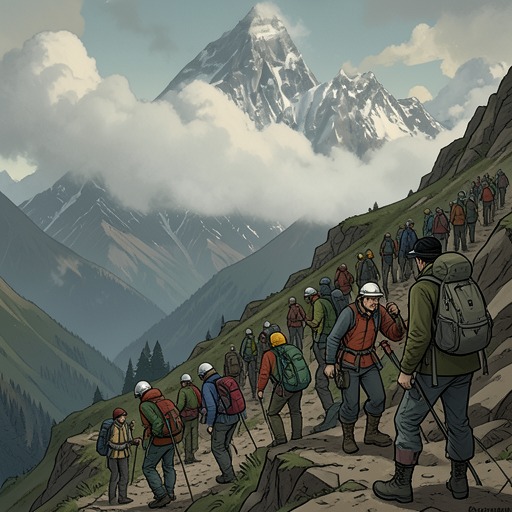
The growth of Everest expeditions is visible in the camp’s changing scale. In the early 1980s, the spring gathering of climbers and support personnel could have fitted into a Paris Metro car. By 1996, more than four hundred people would make the trek and pitch tents, creating a settlement likened to a rock-concert encampment. The size of the crowd was not merely a spectacle: it sharpened questions about who was prepared for the mountain and what commercial access was bringing to it.
The people who made the expeditions possible did not all share the same position in this market. In March, Kami Noru Sherpa and other Sherpas from Pangboche prepared to leave home for work with the teams that had hired them. Their tasks included establishing camps, carrying loads up the mountain, and cooking for and serving the clients. Their pay ranged from $2.50 to $50 a day. The passage places those wages beside the growing number of clients and the large sums attached to guiding, making the distribution of work and financial reward part of the commercial story rather than incidental background.
Clients, competition, and the Everest market
Commercial teams competed not only for summit opportunities but for customers and reputations. Rob Hall’s Adventure Consultants had taken a combined thirty-nine clients and expedition personnel to Everest’s summit since 1990. Its large advertisements promoted success, but the record encountered a reversal in May 1995, when deep snow slowed progress and Hall turned all his clients around without a summit. In 1996 he returned under pressure: success attracted new business, while a turnaround did not. A competing commercial expedition led by Scott Fischer made that market rivalry more immediate.
Fischer’s decision to guide Everest arose from a mix of ambition and financial calculation. Mountain Madness general manager Karen Dickinson described the expedition as a response to client demand and competition, with the possibility of significant profit balanced by the risk of losing heavily. The book also locates this decision within Fischer’s longer effort to build a business that had not consistently supplied a steady income. A successful Everest season, with clients paying $65,000 each at Hall’s asking price, could transform Mountain Madness’s prospects and finance wider changes in Fischer’s life and work.
The company’s commercial campaign also sought recognition. Fischer and his staff promoted the expedition to prospective clients and pursued press coverage; the magazine Outside negotiated for a place on the team for journalist Jon Krakauer, who was commissioned to report on the boom in commercial Everest expeditions. The expedition’s brochure described a system in which guides and high-altitude Sherpa staff would fix ropes, establish and stock a pyramid of camps, and provide leadership for summit attempts, while clients carried light loads to conserve strength. The sales pitch made the division of labor explicit: clients bought access and support, while the expedition staff prepared the mountain and its infrastructure.
Labor, route-making, and decision-making
The commercial structure depended on a great deal of work beyond the summit attempt. Sherpas carried loads and established camps, while the organization of shared route-fixing could itself become a contest over money and authority. In a later account of a season with seventeen teams at Base Camp, climbers debated which Sherpas would fix the Icefall. The teams that organized the work could receive payment, and leaders of other expeditions could then charge for access to a route built with Sherpa labor. The Pangboche Sherpa Cooperative briefly sought the contract, but Henry Todd and Mal Duff secured the work; Duff’s Sherpas hurried to fix the route the teams would use.
That arrangement prompted a critique of who controlled the route and collected its proceeds. The narrator foresaw a system in which Sherpas would fix the entire route to Everest’s summit as contractors and all expeditions would pay them to use it. Nepalese control, in this vision, would replace a system in which foreign expedition leaders benefited from routes built through underpaid local work. The passage’s comparison between the large sums at stake and the hard labor that produced the route makes commercial mountaineering a question of decision-making power as well as expedition cost.
The book also contrasts commercial preparation with the narrator’s Russian high-altitude training, where collective effort and teamwork took precedence over personal ambition, and climbers built experience gradually before moving to 8,000-meter peaks. On a commercial expedition, the narrator understood his role differently: he had been hired to prepare the mountain for clients rather than prepare clients through a long progression before they came to the mountain. He credited Fischer’s sincere effort to assemble a capable team, while recognizing how difficult it was in a short time to select a uniformly strong group of clients and qualified guides. The tension is not simply between skilled and unskilled climbers; it is between the developmental logic of mountaineering and a service model organized around clients’ summit objectives.
Risk, responsibility, and recognition
The business did not end at Base Camp or at the summit. The book’s account of expedition commerce notes that negotiating equipment purchases could be as combative as any ordinary market transaction: each side sought the best price, and the invoice recorded the result. Such arrangements were material to the expedition, but they also became part of the later scrutiny of what resources had been available and how the team had been equipped. Commercial organization therefore connected mundane contracts to high-altitude consequences.
The work of Sherpa teams also had limits that money and plans could not immediately overcome. During another expedition, only eight of sixteen Sherpas remained fit to function. The narrator identified that shortage as a threat to the assault plan and its backup safety arrangements, but did not blame the individuals involved. Developing a Sherpa team able to work together with consistent strength and skill, he argued, required years of repeated ascents and sustained financial support. The observation complicates any image of commercial guiding as a service that can simply be purchased on demand: the capacity on which the service depends takes time, investment, and collective experience to build.
The argument over commercial Everest also became a struggle over public reputation and the responsibilities of guides. After the 1996 disaster, Jon Krakauer’s published account shaped much of the public understanding of Anatoli Boukreev’s actions. Galen Rowell’s May 1997 review of Into Thin Air challenged that portrait, emphasizing Boukreev’s rescues in the storm and criticizing the account’s treatment of his descent ahead of clients. In December, the American Alpine Club unanimously awarded Boukreev its David A. Sowles Memorial Award for repeated efforts to save three teammates trapped by the South Col storm and his final attempt to reach Fischer. The committee’s chair later said that the decision took account of both Boukreev’s nonuse of oxygen and his quick descent ahead of clients; neither fact, in the committee’s judgment, disqualified him from the award.
The dispute did not settle the meaning of guide responsibility. In a public response, Krakauer criticized Boukreev for appearing unrepentant and arrogant and, according to the account, did not acknowledge Boukreev’s complaint that his descent ahead of clients had been approved by Fischer. At a later panel, Krakauer called The Climb dishonest, and David Roberts described it as self-serving; Boukreev, for his part, argued that journalists should take greater care when writing about high-altitude mountaineering. The episode shows how commercial expeditions’ obligations were debated not only through contracts and decisions on the mountain, but also through competing accounts of what clients could expect, what guides owed, and whose interpretation would become public record.
Commercial mountaineering thus appears as an interconnected system of paid access, competitive expedition businesses, specialized labor, route infrastructure, and public claims about responsibility. Its possibility of making a livelihood from climbing is inseparable from its pressures: clients’ ambitions influence how expeditions are organized, Sherpas perform essential and hazardous work for widely varying pay, and the people who control contracts, routes, and publicity can shape both the mountain’s economy and the story told after a disaster.